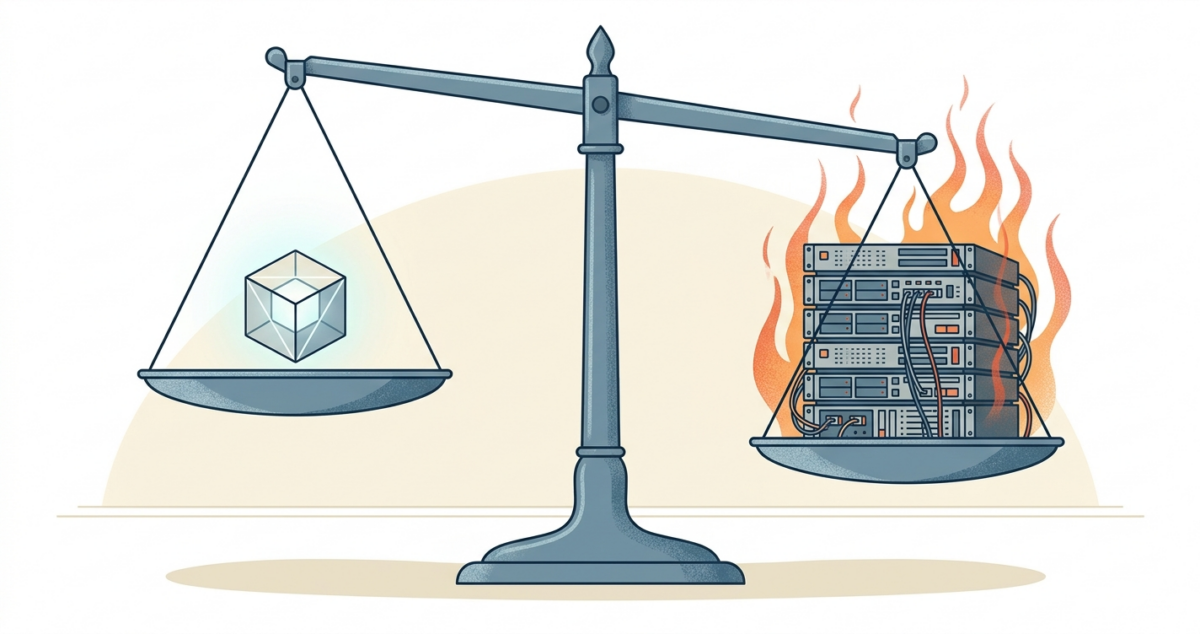
It all comes down to where the work happens.
There’s a technology choice that sits at the heart of every AI avatar platform, and most people deploying avatars never think about it. But it determines — almost mathematically — how much you’ll pay as your usage grows. Understanding it takes about five minutes, and it could save you a significant amount of money.
Let’s talk about where the video gets made.
Two Fundamentally Different Architectures
When a visitor interacts with an avatar on a website, something has to produce the video frames you see on screen. There are two very different places that can happen:
Server-side video generation is the approach taken by the new wave of GenAI avatar platforms. When your visitor speaks or types, their input is sent to a cloud server, which runs a generative AI model to produce a video stream of a photorealistic speaking avatar in real time. The video is then compressed and streamed back to the user’s browser.
Client-side 3D rendering is the approach SitePal uses. The avatar itself — a 3D animated model — runs in the visitor’s browser. The browser’s own graphics engine drives the animation in real time. The server’s job is simply to deliver the audio and animation cues. The heavy lifting happens locally, on hardware the user already owns.
That distinction sounds technical. But its economic consequences are significant.
The Cost Is in the Physics
Generating photorealistic AI video in real time is computationally expensive. It requires dedicated GPU processing — the same kind of hardware that trains large AI models — and it requires it continuously, for every second of every interaction, for each user.
There is no shortcut. The cost is built into the approach. A server-side GenAI avatar platform isn’t overcharging because it wants to; it’s passing along the unavoidable cost of the infrastructure required to do what it does. Every minute of video generated consumes GPU time, which has a real dollar cost — typically in the range of $0.14 to $0.35 per minute, depending on the provider and plan.
And here’s the thing: that cost scales directly with usage. Serve one user? Pay for one user’s GPU time. Serve ten thousand users? Pay for ten thousand users’ GPU time. There is very limited economy of scale when the core product is real-time video generation.
Client-side rendering works the opposite way. The 3D avatar model is delivered once. After that, it runs on the visitor’s device, with marginal cost per additional interaction. Serve one user or a thousand users with only a small increase in cost. Flat-rate pricing becomes possible — it’s the natural consequence of the architecture.
Credit Where It’s Due
Before we get to the numbers, it’s worth pausing on something. The fact that server-side GenAI video avatars cost a lot to run isn’t a criticism of the companies building them. It’s a reflection of what they’re doing.
Generating a photorealistic, expressive, lifelike video avatar in real time from a text or audio input is a genuinely impressive technological feat. It requires significant time spent on model development and expensive infrastructure to deliver. The cost is an honest reflection of the computational investment involved.
At the same time, it brings up an important question for anyone deploying avatars at scale: is the visual realism worth the cost? And the honest answer is: it depends entirely on what you’re using the avatar for.
What the Numbers Actually Look Like
To move beyond the theory and look at actual prices, we identified companies providing GenAI real-time avatar service and selected one whose published pricing appeared to be the most competitive. We then conducted a structured cost comparison across three representative usage profiles.
Here’s what we found.
Profile 1 — Small deployment: approximately 2,500 video minutes per month. A modest use case — a customer service bot or a product explainer on a small business website.
Profile 2 — Mid-size deployment: approximately 10,000 video minutes per month. A more meaningful B2B or e-learning deployment, or a mid-traffic website with an AI assistant.
Profile 3 — Major deployment: approximately 60,000 video minutes per month. A higher-traffic deployment — perhaps an e-learning platform, a busy customer support integration, or enterprise internal tooling.
The Results
| Usage Level | SitePal (monthly) | GenAI Video Platform (monthly) | Multiplier |
| ~2,500 video min/mo* | $20 | $429 – $719 ** | 21× – 36× |
| ~10,000 video min/mo* | $38 | $1,822 – $2,919 ** | 49× – 78× |
| ~60,000 video min/mo* | $217 | $11,005 – $17,419 ** | 51× – 80× |
* SitePal does not measure usage in video minutes, but in audio Streams. In our experience average stream length with online avatars is about 20 sec. So for this study we used the equivalence: 1 video minute = 3 audio Streams.
** The GenAI platform figures show a range reflecting different plans and features, and include overage costs as required. SitePal figures reflect the monthly cost of the applicable annual billing plan. No overages were required.
A few things stand out immediately:
The gap is large at every scale. Even at the smallest profile — around 2,500 video minutes per month — the cost difference is 21 to 36 times. This isn’t a minor pricing nuance. It’s a structural difference rooted in the architecture.
The gap widens as volume grows. At the largest profile, the multiplier reaches 51× to 80×. SitePal’s Platinum plan covers unlimited interactions for $216.63/month. The equivalent server-side volume would cost five figures monthly. This is the unlimited-scale consequence of near-zero marginal cost.
The annual cost gap is staggering. At 10,000 video minutes per month, the annual difference is roughly $21,000 to $35,000 — versus $374.60 for SitePal. At 60,000 video minutes per month, the GenAI platform’s annual bill could approach or exceed $200,000, while SitePal’s is $2,600.
Finally – it should be noted that in enterprise use cases, usage may exceed the above noted profiles many times over.
A Place for Each Solution
These numbers strongly favor using client-side rendering in the majority of deployment scenarios. But we do not argue that server-side GenAI video avatars have no place. They do — and it’s worth being clear about where.
The case for a photorealistic GenAI video avatar rests on a simple premise: when the human-avatar interaction is high-stakes enough, and the value of visual realism is high enough, the cost can be justified. Examples of real life scenarios where this is true may include the following.
The high-stakes, high-value case: Imagine a 1-on-1 virtual sales consultation where a senior executive’s avatar engages a qualified enterprise prospect. Or a premium advisory session where a financial planner’s digital presence guides a client through a significant investment decision. Or a concierge healthcare service where a patient interacts with a virtual physician’s avatar for a follow-up consultation. In these settings, the conversation may generate (or save) thousands of dollars in value, the audience is a single person, and visual realism may meaningfully affect trust and outcome. Spending in the five-figure range annually for such use cases may be entirely justified.
The mass deployment reality: Now imagine deploying that same technology as an FAQ assistant on a website, a learning module in an online course, a customer onboarding flow in a SaaS product, or a voice assistant in an employee training program. The audience is thousands of users, the per-interaction value is modest, and the cost at scale becomes prohibitive. As our study shows, what starts as a $200/month plan quickly becomes a $2,000+ or $10,000+ monthly bill once real usage kicks in — often catching teams off guard when the invoice arrives.
The key is matching the technology to the scenario. Server-side GenAI video avatars are a premium product with premium pricing — appropriate for a narrow class of high-value, low-volume, high-trust interactions where photorealism genuinely moves the needle. Client-side 3D rendered avatars are a scalable infrastructure product — appropriate for a vast majority of real-world deployments where reach, reliability, and cost-efficiency matter most.
Summary
The cost difference between server-side GenAI video avatars and client-side 3D animated avatars isn’t a pricing strategy. It’s physics. Generating photorealistic real-time video requires GPU compute at scale; rendering a 3D animated avatar runs in the visitor’s browser for free. The economics follow directly.
Our pricing study — comparing SitePal against the most competitively priced GenAI avatar platform we could find — found a cost differential of 21× to 80× depending on usage volume, with the gap growing at higher volumes.
For most avatar deployments — e-learning, customer service, website assistants, onboarding, sales enablement at scale — that cost difference can be decisive. For the narrow class of high-value 1-on-1 interactions where visual realism justifies the premium, the calculus changes.
Know what you’re building. Know what you’re paying for. And make sure the architecture matches the use case.
SitePal has been the world’s leading platform for animated speaking avatars for over 25 years. Our avatars run client-side — meaning you can serve audiences of any size without runaway infrastructure costs. Explore SitePal plans →